Engineering got 10x faster.
Coordination didn't.
AI agents solved the throughput problem. A developer with Cursor or Copilot closes 10 tickets a day. Code generation is no longer the bottleneck. For the first time in the history of software engineering, writing code is the easy part.
But nobody increased the coordination bandwidth. The standup is still 15 minutes. The review capacity did not grow. The org chart did not change. Throughput went up 10x. Coordination capacity stayed flat.
This is the gap Zamski was built to address. Not the speed of code. The visibility of coordination.
The Ripple Effect
More code means more pull requests. More pull requests means more review burden. More tickets closed means more context to track across more people. More generated code means less institutional knowledge of what was built and why.
These are second- and third-order effects of AI velocity, and they are where real operational risk lives. A developer ships three PRs in one morning. Each one is locally correct. But together, they touch the same module that two other developers are also modifying, and nobody knows.
Historically, managers absorbed this burden. They tracked dashboards. They cross-referenced Jira, GitHub, Slack, calendars, and meetings. They acted as the human coordination layer.
AI agents were supposed to reduce that overhead. Instead, most organizations are discovering that the overhead shifted. It did not disappear. It became less visible.
The Dashboard Problem
Dashboards show you that cycle time went down. They do not show you that 3 people are unknowingly rewriting the same module.
They do not show you that a Slack conversation about a risk never became a ticket. They do not show you that the team's velocity looks great because AI agents generated 60% of the PRs and nobody reviewed them carefully.
Dashboards report activity. They do not explain coordination. They summarize metrics after the fact. They show you that something happened without telling you whether the things that happened are consistent with each other.
More dashboards do not solve a visibility problem that exists between tools. The gap is not in any single system. The gap is in the space between all of them.
A Different Question
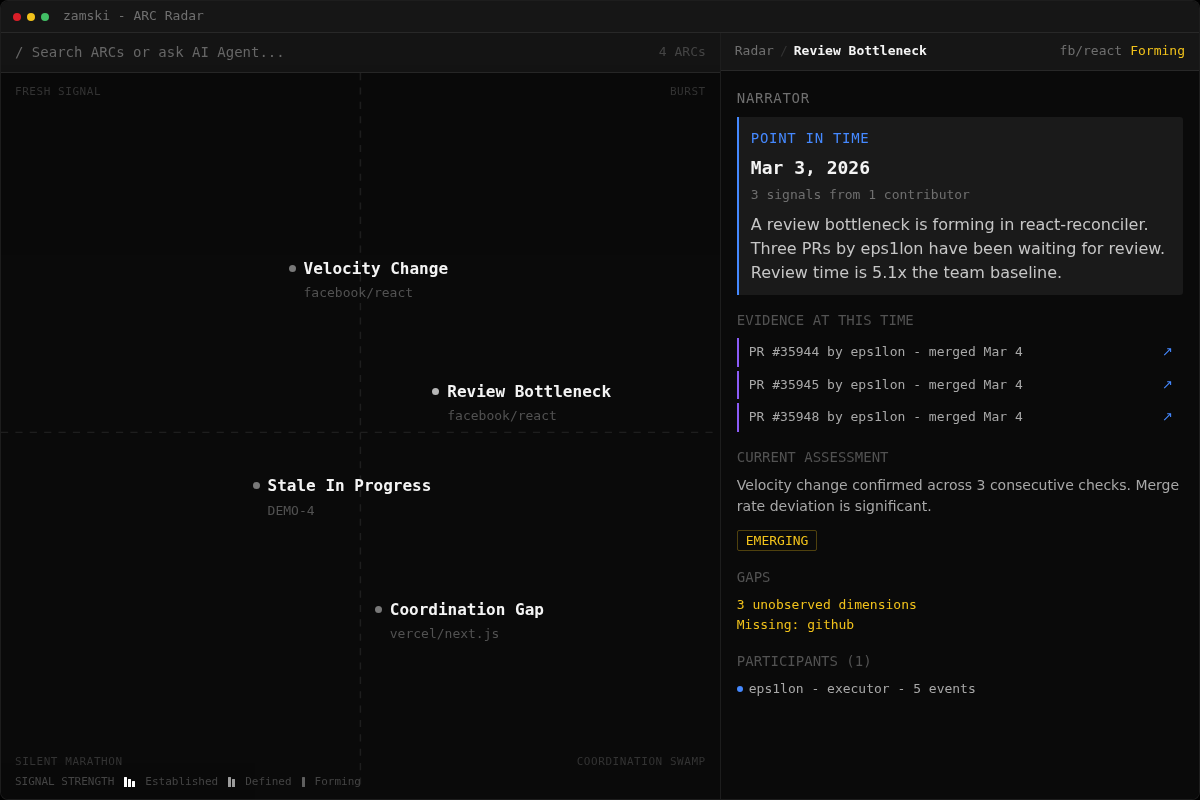
Zamski was built to address this gap. Not by creating another dashboard, and not by adding another agent. By watching all the activity across your tools and detecting the coordination patterns that nobody can see in any single system.
The question is not "what did the AI do?" The question is: what coordination patterns are forming that nobody can see in any single tool?
That is the pivot from productivity measurement to engineering intelligence. From counting outputs to understanding how the work connects.
When Systems Tell Different Stories
Most operational failures do not come from a single bad decision. They come from misalignment. Work drifts apart across systems while everyone believes things are under control.
AI agents accelerate this drift. A Slack bot summarizes a discussion and posts a conclusion. A Jira agent updates a ticket status to "In Progress." A GitHub agent opens a pull request with autogenerated code.
Each action is locally correct. None of them, on their own, are wrong. But together, they can create a coordination gap that no single tool can see.
From Jira's perspective, work is progressing. From GitHub's perspective, code exists. From Slack's perspective, a decision was made. From the team's perspective, nothing is actually aligned.
Activity Across Every System
Traditional monitoring breaks down here. Dashboards report activity within a single tool. Alerts trigger on thresholds within a single system. Status fields change without explaining whether the underlying coordination still holds.
Humans intuitively track these gaps. A manager notices that a ticket says "Done," but no one remembers reviewing the PR. A tech lead senses risk because a Slack discussion never turned into an action. These are soft signals. Contextual, cross-system, and temporal. They are exactly the signals most tools ignore.
Zamski treats this as a first-class problem. It watches observable activity across every connected system: tickets, PRs, commits, Slack threads, calendar events, documents. It normalizes them into a shared event model. Then it detects patterns that span multiple tools.
The insight is not "Jira and GitHub disagree." The insight is "three teams are converging on the same codebase without knowing about each other, and the review queue is growing while the sprint clock is running out."
ARCs, Not Alerts
Alerts imply urgency. They also create fatigue. The world is full of things that are imperfect but not urgent.
Zamski uses a different primitive: an ARC. An ARC is a living narrative that evolves as new signals arrive. It carries uncertainty proportional to its evidence. It resolves when the pattern resolves.
An alert says "threshold crossed." An ARC says "this pattern has been building for 2 weeks, involves 5 people, is 5x your team's baseline, is related to a coordination gap in the same module, and is getting worse."
ARCs are not "something is broken." They are "a coordination pattern is forming that you should understand." The UI stays calm. No fake critical badges. No confidence theater. Just the evidence, the narrative, and the trajectory.
Not Monitoring. Engineering Intelligence.
Most monitoring tools are built on the same underlying assumption: the system is healthy if the metrics are healthy. That works for infrastructure. It fails for coordination.
Zamski is not trying to monitor systems. It is trying to surface the coordination reality that exists between systems.
The unit of value is not "events per second." It is "a pattern that changes how you understand what is happening." Zamski ingests a limited set of high-value work evidence: tickets, PRs, commits, Slack threads, calendar events. It normalizes them into a shared event model. Then it runs 14 evaluators calibrated to your team's rolling baselines.
Every derived insight links back to specific evidence. Every narrative is grounded in observable signals. Every ARC has a timeline you can walk through event by event. The system can say: "This ARC exists because these exact signals converged. If any of those inputs change, the narrative changes."
This is not monitoring. Monitoring tells you something is wrong. Zamski tells you what coordination pattern is forming, why it matters, and how it is changing.
A Concrete Example
Consider a common, unremarkable sequence of events.
A Slack thread starts in an engineering channel. An engineer raises a concern about edge cases in a new feature. Another engineer responds with a proposed approach. A tech lead replies with something that sounds like a decision: "Let's ship the simpler version now and handle the edge cases in a follow-up."
No ticket is created. No owner is explicitly assigned. The conversation ends. From Slack's perspective, this is a closed thread with a decision.
A day later, a Jira ticket related to the feature is moved from "In Progress" to "Done." The assignee believes the decision in Slack resolved the open questions. Jira now claims the work is complete.
Shortly after, a GitHub pull request is opened. It contains the core implementation, but none of the edge cases discussed in Slack. The PR is reviewed quickly and merged. From GitHub's perspective, the code exists, was reviewed, and shipped.
Individually, every system looks healthy. Slack shows a resolved discussion. Jira shows completed work. GitHub shows merged code. There are no errors. No alerts fire. No dashboards turn red. But the coordination gap is already forming.
Zamski would surface this as an ARC: a decision leak. A Slack discussion produced an outcome that never reached the systems that track work. The narrative would name the participants, the timeline, and the gap. It would carry low confidence initially, growing stronger as the "follow-up" ticket never appears.
Weeks later, without Zamski, a downstream team is blocked. A customer reports unexpected behavior. The original Slack thread is long gone. The Jira ticket is closed. The PR looks correct in isolation. No one can easily explain how this happened.
Coordination at the Speed AI Enables
The question is not whether AI makes engineering faster. It clearly does. The question is whether your organization can coordinate at the speed AI enables.
Most systems cannot answer that. They can only report their own view. Zamski exists to bridge that gap. It does not replace Jira, Slack, GitHub, or AI agents. It sits across all of them, detecting the coordination patterns that form between them.
It makes second- and third-order effects visible without drowning teams in telemetry. It reduces management overhead by shrinking ambiguity, not adding dashboards.
If the answer to "can we coordinate at AI speed?" is "we don't know," that is what Zamski is for.