Your AI agent writes code. It doesn't know what's happening around it.
When Claude Code, Cursor, or any AI agent works on a file, it doesn't know that 3 other people modified the same module this week. It doesn't know that a Slack thread decided on a different approach yesterday. It doesn't know that a review bottleneck is blocking everything in this area. Zamski's MCP server gives your agent the organizational context it's missing.
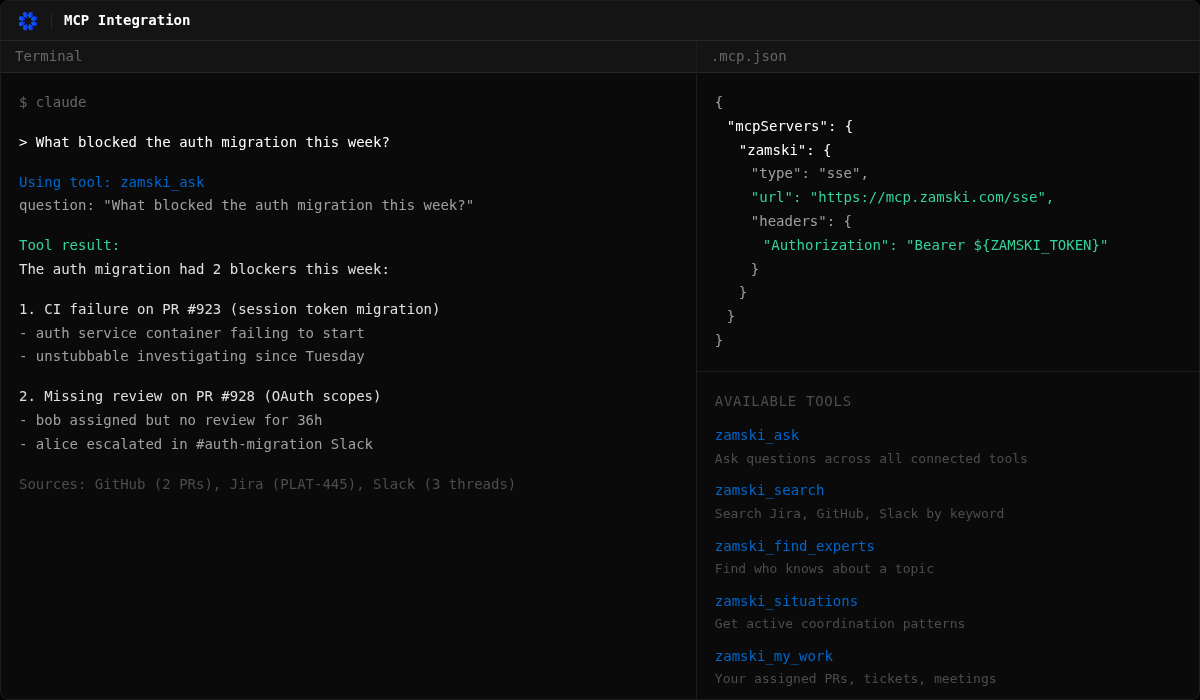
15 tools. Every tool your agent needs to code with context.
Note: the API uses "situations" as the technical term for what we call ARCs.
Before you code
Check what is happening around the files you are about to modify.
zamski_file_contextWho else is working here? Are there open PRs, related tickets, active ARCs? Who is the domain expert?
zamski_work_item_contextEverything about a ticket: description, team comments, acceptance criteria, Slack decisions, PR feedback, meeting notes.
Understand the organization
Search across every platform your team uses.
zamski_searchCross-platform search across Jira, GitHub, and Slack in one call.
zamski_askNatural language question routed through chain reasoning. Returns answers with sources, confidence, and reasoning steps.
zamski_find_expertsWho should review this change? Ranked experts with expertise scores and recent activity.
Know what matters
See the coordination landscape before making decisions.
zamski_situationsActive ARCs from the spatial radar, sorted by gravity. Pattern type, severity, signal count, kinetic state.
zamski_view_situationDeep dive into a specific ARC. Narrative, spatial metrics, related signals.
zamski_intelligence_feedScored intelligence feed. Critical, high, medium, and low items with explanations and evidence.
zamski_briefDaily intelligence brief. Top ARCs, alerts, personal metrics, sprint health.
Manage your work
Track what needs attention.
zamski_my_workYour assigned PRs, tickets, calendar items, and items needing attention.
zamski_meeting_decisionsRecent meeting summaries with decisions and action items. What was decided in the last standup?
zamski_triageUnclassified signals not yet linked to any ARC.
Take action
Create and link organizational context.
zamski_create_situationCreate an ARC when you spot a pattern the evaluators have not detected yet.
zamski_tag_situationLink PRs, tickets, or commits to an existing ARC.
What changes when your agent has context
Install in 30 seconds
For Claude Code
Add to .mcp.json in your project root:
Then authenticate:
For Cursor and other MCP-compatible agents
Same configuration. Any agent that supports the Model Context Protocol can connect.
Authentication options
Interactive login (device code flow) for individual developers
Access token (environment variable) for CI and automation
Not another code search plugin
Cross-platform context, not just code
Most agent plugins search code. Zamski searches Jira tickets, Slack threads, meeting decisions, calendar patterns, and code. The agent gets the full picture.
Organizational intelligence, not just data
zamski_ask doesn't return search results. It routes through chain reasoning with access to expertise models, cross-platform identity resolution, and ARC narratives. Answers include confidence scores and sources.
Coordination awareness
No other MCP plugin tells your agent "there is an active review bottleneck in this area" or "two other people are modifying related files this week." This is the gap between coding alone and coding as part of a team.
On the roadmap
Real-time ARC updates via WebSocket so agents get notified when coordination patterns change during long sessions
Proactive conflict detection that warns BEFORE you create a conflicting change
Embedding-based semantic code search to find patterns like "all error handling similar to this"
Review load balancing that suggests reviewers based on capacity and domain knowledge
Narrative history showing how a file participated in resolved ARCs over the last 90 days
Give your AI agent the context it's missing.
15 tools. One MCP server. All the organizational context your agent can't see on its own.