Connect your tools. Zamski tells the story.

Zamski connects to GitHub, Jira, Slack, Confluence, Calendar, and Zoom. It watches engineering activity in real-time, detects coordination patterns across systems, and builds evolving narratives about what is happening in your organization.

Three layers of intelligence
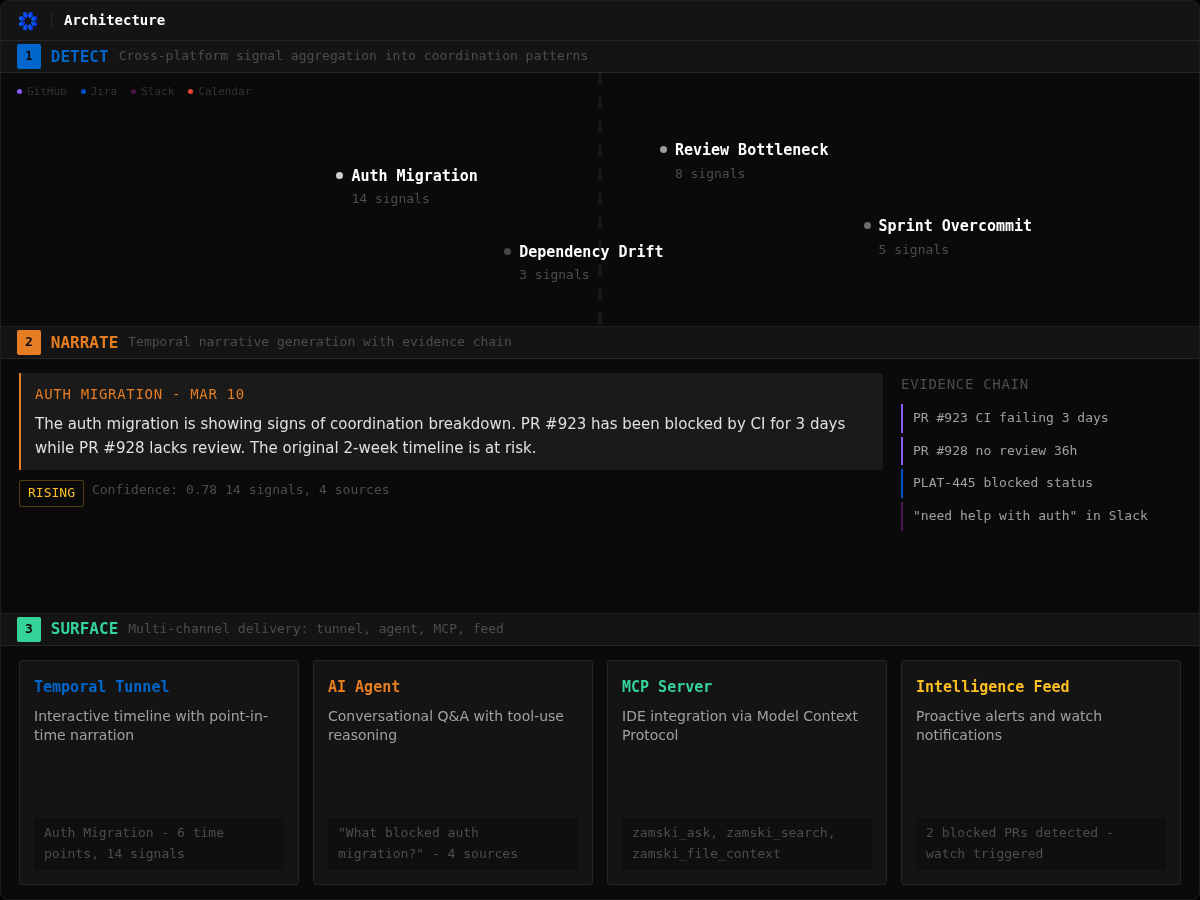
Three-layer intelligence architecture: Detect cross-platform signals, Narrate with temporal context, Surface through multiple channels
01

Detect

14 evaluators analyze engineering activity in real-time. Review bottlenecks, coordination gaps, velocity changes, stale work, undocumented decisions, untracked risk. Each calibrated to your team's rolling baselines, not generic thresholds.

When multiple patterns co-occur in the same area, a synthesis engine connects them: "review bottleneck + stale work + untracked risk in the same module = capacity constraint."

02

Narrate

Each detection becomes an ARC with an AI-generated narrative that explains what is happening, who is involved, and how it connects to other patterns. Narratives build on previous cycles. "Since the last assessment, PR #412 was reviewed, but two new PRs joined the queue."

The narrative carries uncertainty language proportional to evidence: "Early signals suggest..." (2 data points) vs "Analysis confirms..." (25 data points, 3 sources, 4 weeks of evidence).

ARC narrator panel showing point in time, evidence, assessment, and participants
03

Surface

ARCs appear on a spatial radar organized by team breadth (how many people involved) and time depth (how long the pattern has been building). A review bottleneck involving 5 people over 3 weeks looks different from a fresh signal involving 1 person today.

Click any ARC to enter the temporal tunnel and explore the full timeline of events.

Temporal tunnel with breadcrumb navigation, narrative filmstrip, and signal cards

What happens under the hood

01Ingest
Webhook arrives - PR merged, ticket updated, Slack message, calendar event
02Store
Cortex writes to graph database with cross-platform identity resolution
03Enrich
Temporal workflows update expertise vectors, cross-references, and file clustering
04Evaluate
Synapse runs 14 evaluators against team-relative baselines
05Synthesize
Cross-evaluator engine groups related findings into compound patterns
06Narrate
LLM generates narrative using team baselines and previous assessment history
07Publish
Snapshot published. Radar updates in real-time via WebSocket.

Technical differentiators

Event-driven architecture (RedPanda)Not batch. Not cron. Real-time.
Graph database (ArangoDB)Cross-platform identity resolution across all your tools.
Team-relative baselinesComputed from 90 days of your team's history. Not generic thresholds.
Semantic file clusteringEmbeddings group related files, not just files with the same name.
Narrative continuityThe LLM reads its previous assessments. Each cycle builds on the last.

Dashboards summarize. Zamski narrates.

CapabilityDashboards (LinearB, Jellyfish)Zamski
MetricsCycle time, DORA, velocity chartsNarrative patterns with causal context
ThresholdsGeneric (same for every team)Team-relative (your team's P50/P75/P90)
Cross-systemSingle-source or manual correlationAutomatic across GitHub + Jira + Slack + Calendar
AI awarenessNot designed for AI-generated workBuilt for teams using AI coding agents
OutputCharts and numbersLiving narratives that evolve
DetectionThreshold alerts14 evaluators + 8 compound patterns
IntelligenceWhat happenedWhat happened, why it matters, how it is changing

See what your tools are missing.

Try it now